
Column
The Plateau – A Green Lung at the Heart of a Prized Sector
Jean Giguère
Author :
WikiResidence
Source :
07/12/25
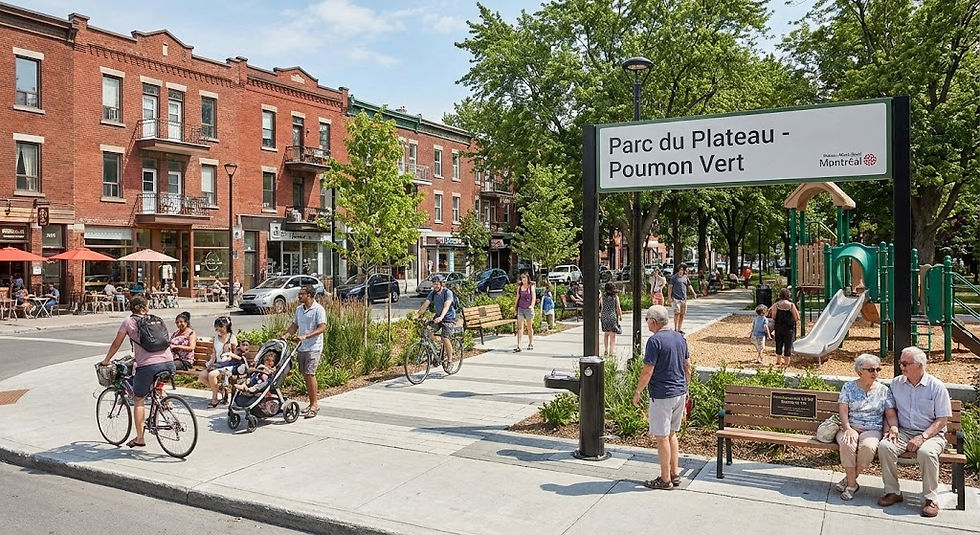
The Plateau-Mont-Royal annually injects $5.9 million into the maintenance, renovation, and development of its parks and public infrastructure.
This substantial budget is not just an expense, but a strategic investment aimed at consolidating the quality of life in the borough, supporting the local economy, and addressing constantly increasing usage.
We break down this financial program and its concrete benefits for residents, from its impact on property values to the social benefits of green spaces.
The Economic Stake
The Plateau-Mont-Royal, with its high population density and attractiveness, faces constant infrastructure needs.
The annual budget of $5.9 million for parks and infrastructure (including landscaping, street furniture, pathways, and service buildings within the parks) demonstrates a clear priority for the Borough.
This investment has a direct economic impact:
Support for Local Employment: Renovation and development projects mobilize entrepreneurs, landscape architects, and workers, injecting capital into the regional economy.
Increase in Property Value: Studies show that a dwelling located near a well-maintained park or quality infrastructure (e.g., safe bike paths, friendly streets) can see its value increase by 5 to 15%. The investment thus helps maintain the appeal and wealth of the Plateau's real estate portfolio.
Commercial Attractiveness: Pleasant public spaces encourage strolling and increase the time spent in the neighborhood, which directly benefits local businesses.
Usage Statistics
The pandemic highlighted citizens' reliance on green spaces.
The Plateau, one of Montreal's most densely populated boroughs, sees its parks become essential gathering places.
Rising Attendance: Some emblematic Plateau parks, such as Parc La Fontaine (though partially in Ville-Marie, it is central to the Plateau) or Parc Baldwin, record attendance increases of around 20 to 30% compared to pre-pandemic figures, particularly during the warm seasons.
Accelerated Wear and Tear: This overuse puts equipment under significant strain.
A significant portion of the $5.9M budget is therefore dedicated to preventive maintenance and the early replacement of infrastructure (children's play areas, benches, drinking fountains), whose lifespan is reduced by intense use.
Social Impact and Quality of Life
The social impact of this investment is paramount in the context of sustainable urban development.
Reduction of Urban Heat Islands (UHI): A portion of the budget is systematically allocated to tree planting and the development of permeable surfaces.
This is crucial for summer comfort and public health. UHIs can exacerbate respiratory problems; green spaces act as natural air conditioners.
Inclusion and Accessibility: Funded projects must comply with universal accessibility standards.
The goal is to ensure that all residents—seniors, people with reduced mobility, families with strollers—can enjoy the infrastructure.
Community Ties: Parks are catalysts for neighborhood life. Investments in specific amenities (picnic areas, renovated sports fields, community gardens) strengthen the sense of belonging and promote social interactions, which are essential to the Plateau's community fabric.
The amount of $5.9 million is not just a simple figure in a budget table.
It is a roadmap for a Plateau that is resilient, attractive, and inclusive.
For real estate stakeholders, this strong commitment to public infrastructure is a clear signal: investing in the neighborhood's quality of life is a safe bet that will continue to support demand and the property premium in this sought-after sector.
Comparative Analysis
The Plateau-Mont-Royal's annual investment in local parks and infrastructure is significant, but how does it compare to other Montreal boroughs, which manage territories and populations of varying sizes?
Comparatively, the budgets allocated to parks and infrastructure are often grouped under broader headings (Recreation, Culture, Development, Roads), which makes a direct comparison difficult. However, by analyzing public budgets, certain trends emerge.
The Density Challenge: Plateau vs. Villeray–Saint-Michel–Parc-Extension (VSP)
The Plateau is one of the most densely populated boroughs in the metropolis. Its parks experience much faster wear and tear than those in less concentrated areas.
Borough | Parks & Infrastructure Budget (Annual) | Type of Expenditure | Usage/Constraint |
Plateau-Mont-Royal | $5.9 M | Annual maintenance, renovation, and development | Very high density, rapid wear and tear, limited space. |
VSP (PDI Average) | $\approx$ $1.66 M | Redevelopment of parks (10-year Capital Investment) | Medium density, larger park area. |
The Plateau's annual budget ($5.9M) is three times higher than the average annual capital budget for park redevelopment in VSP (approx. $1.66M per year over a $16.58M 10-Year Capital Program).
This difference highlights that the Plateau's investment is heavily weighted toward maintenance (operational) and asset sustainment costs necessary to serve a population highly concentrated in a small area. The Plateau is paying for the intensity of use.
2. The Contrast with Large Territories: Plateau vs. Saint-Laurent
Geographically larger boroughs, such as Saint-Laurent, have much larger overall budgets for all local services.
Borough | Budget Category (Annual) | Allocated Amount (Annual) | Scope |
Saint-Laurent | Recreation and Culture, including park maintenance | $30.2 M (out of a total budget of $81.3 M$) | Very large territory including large nature parks, pools, libraries. |
Plateau-Mont-Royal | Parks and Infrastructure | $5.9 M | Budget focused on parks, street furniture, and pathways. |
Although Saint-Laurent allocates over $30 million for its recreation and park maintenance, it should be noted that this budget covers culture, libraries, and sports facilities over a much larger territory than the Plateau.
The Plateau's budget, though smaller in absolute terms, therefore represents one of the highest concentrations of investment per square meter of park and per inhabitant in the city, aiming to optimize every piece of green space.
3. The Scale of Capital Investment (PDI)
At the City of Montreal level, the 10-Year Capital Expenditure Program (PDI) 2025–2034 plans for an investment of $3.892 billion over 10 years for all "Parks, green spaces, and playgrounds" in the agglomeration (an average of approximately $389M per year for the entire city).
The Plateau's budget must fit within this envelope, but it is primarily funded by borough taxes for maintenance and small projects.
Economic Impact Per Capita
What distinguishes the Plateau is not just the amount, but its leverage effect.
The high property tax revenue of the Plateau (due to high real estate values) allows it to sustain a high level of service.
The $5.9 M investment in a smaller but high-value territory is a key factor in stabilizing and increasing the wealth of the borough.
In other words, the money is reinvested into what constitutes the neighborhood's premium: its public spaces.
The Plateau's budget for its parks and infrastructure is not outstanding in its absolute amount compared to larger boroughs like Saint-Laurent. It stands out, rather, for its concentrated and critical nature for maintaining the quality of life in a very dense environment.
It is a budget of excellence for a neighborhood that lacks the spatial maneuvering room of its neighbors.