
News
The New Ahuntsic-Cartierville
Jean Giguère
Author :
WikiResidence
Source :
05/04/26
In this podcast, we analyze the strategic shift in the Ahuntsic-Cartierville borough
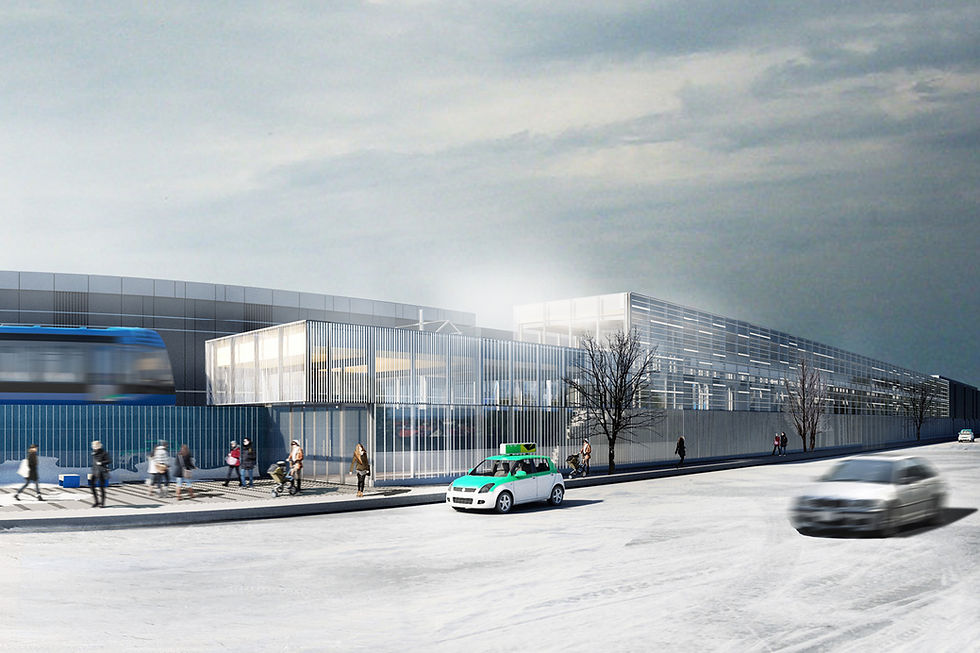
With the arrival of the Réseau express métropolitain (REM), the city is injecting millions to transform one of Montreal’s most anxiety-inducing intersections—the Acadie/Henri-Bourassa crossing—into a safe and fluid corridor leading to the Du Ruisseau station.
The attractiveness of these transit hubs is also driving the emergence of several major residential complexes.
Safety and the REM:
Montreal’s urban planning is at a major turning point, and the western sector of Ahuntsic-Cartierville serves as its perfect laboratory.
Long perceived as a car-dominated transit zone, the neighborhood is reinventing itself under the influence of a colossal transport infrastructure: the REM.
The Gordian Knot: Acadie / Henri-Bourassa
The intersection of Acadie and Henri-Bourassa boulevards has long been at the top of the city's "most dangerous" lists.
With traffic flows often exceeding 45,000 vehicles per day, the coexistence of heavy trucks, cars, and pedestrians had become untenable.
The budget allocated for securing this sector falls under the Vision Zero plan. Planned interventions include:
Street geometry redesign to reduce pedestrian crossing distances.
Priority signals for active transportation (cyclists and pedestrians).
Reconfiguration of access ramps to limit turning conflicts.
Connectivity to Du Ruisseau Station
The Du Ruisseau REM station is the future heartbeat of local mobility.
However, its value depends entirely on its accessibility.
The borough is investing heavily in "last-mile connectivity."
The goal is simple: allow residents to reach the station in less than 10 minutes by bike or on foot, in a safe and pleasant manner.
Economic Insight: According to real estate projections, improved connectivity to a structural transit station can lead to a property value increase of 5% to 12% for residential buildings within an 800-meter radius.
Figures and Budgets
The budget for active mobility and safety infrastructure amounts to millions of dollars, partially funded by the City of Montreal’s Ten-Year Capital Works Program (PDI).
Estimated Budget: Over $15 million for the initial phases of securing and cycling development in the western axis.
Expected Ridership: Du Ruisseau station forecasts a daily ridership of several thousand users, requiring widened sidewalks capable of absorbing these new mobility flows.
Social Impact
The social impact is profound.
Securing the Acadie/Henri-Bourassa intersection helps decluster certain social and affordable housing sectors located nearby.
By reducing the "urban fracture" created by large boulevards, the city promotes social diversity and access to employment.
The safety of seniors and families—who are particularly numerous in this sector—is at the heart of the municipal strategy.
Real Estate: The REM as a Catalyst
The REM is acting as a major catalyst for real estate development, particularly around the Du Ruisseau station and the Acadie/Henri-Bourassa axis. Here is an overview of the projects redefining the neighborhood:
1. Flagship Real Estate Projects
Crown Condominiums (Meilleur St.): A modern complex on a former manufacturing site near the train station.
Developer: Groupe Immobilier Scalia | Architect: Rocio Architecture.
Units: ~390 units (studios to 3-bedroom, and lofts) over 7 phases.
Impact: Revitalizes an underutilized industrial zone and integrates 73 social housing units in Phase 7.
Henri B (Basile-Routhier St.): A model of Transit-Oriented Development (TOD) at the Henri-Bourassa Metro.
Developer: TGTA & Loracon | Architect: BLTA.
Units: 209 condos.
Impact: Contributed over $154,000 to the affordable housing fund; replaced a concrete bus terminal with a green living space.
ALDEA Ahuntsic (Sauvé St.): High-quality rental alternative by MONDEV.
Architect: Forme Studio Architectes | Units: ~110 rental units.
Clientele: Students and healthcare workers.
Impact: Addresses the shortage of new rental housing in a sector dominated by older multiplexes.
Bois-Franc Development (Bordering Saint-Laurent): Luxury townhomes and condos 15 minutes from downtown.
Developer: Groupe Montoni | Architect: Sid Lee Architecture.
Budget: $100 million investment; launch in September 2025.
Impact: Includes a secured "pedestrian porte-cochère" linked directly to the REM.
2. Local Market Trends
Property Valuation: In 2025, the median price for single-family homes in Ahuntsic hit $880,000 (a 7% annual increase).
Strategic Density: The borough now prioritizes multi-residential projects (6+ stories) near stations.
Social Mix: Inclusion of projects like Hapopex on Henri-Bourassa to prevent displacement due to speculation.
3. Urban Transformation
The neighborhood is seeing a total infrastructure overhaul, including new multi-functional paths and commercial revitalization (cafés and services on ground floors), turning industrial zones into complete living environments.
Ahuntsic-Cartierville is no longer just a transit zone.
The sector has become a destination of choice for young professionals and families seeking a green neighborhood with rapid downtown access.
The total investment signals massive confidence in the growth potential of the area for 2026 and beyond.