
News
The Coulée Grou Project -200 Social Housing Units in Pointe-aux-Trembles
Jean Giguère
Author :
WikiResidence
Source :
25/06/26
After six years of complex planning, the groundbreaking for the Coulée Grou real estate project finally took place at 15 777 Sherbrooke Street East, in Pointe-aux-Trembles (PAT).
Valued at $96 million, this vast construction site will transform the grounds of the former Pignons Rouges motel—once prestigious but recently abandoned—into a vibrant and inclusive living environment.
Scheduled to welcome its first tenants in the fall of 2028, this initiative will offer 200 social and community housing units. Through its multi-party financing, environmentally focused architecture, and strong social vocation (with an exceptional proportion of large apartments for families), this project marks a crucial step in combating the housing crisis in Eastern Montreal.
Today, we are looking at a project that perfectly embodies urban resilience and social engineering: the Coulée Grou project, located in Pointe-aux-Trembles.
The land that will host these new buildings, nestled near the Coulée-Grou park, carries a contrasting history. Formerly occupied by the Pignons Rouges motel, a prestigious address in the neighborhood, the site had sadly lost its luster over the years, even becoming a haven for squatters.
As Chantal Rouleau, MNA for PAT and Minister, pointed out, the acquisition of this neglected land makes it possible to "restore its former glory" by integrating it into a direct solution to the housing crisis.
A Major Social Impact:
The success of an urban development project is not only measured in poured concrete, but in transformed lives. Managed by Gérer son quartier and coordinated by Bâtir son quartier (backed by 40 years of experience), the Coulée Grou project was designed to maximize social impact and respond to diversified occupancy needs.
To foster genuine social mix, the developers made a bold decision: dedicating a significant portion of the complex to large families, a segment often neglected in new builds. Michel Taylor, Chairman of the Board of Directors of Gérer son quartier, insists on this point: "39% of the units have three or four bedrooms. I think it is very important to have apartments with several bedrooms when you want to promote social mix."
The direct economic and social impact for residents is immense. Out of the 200 households, up to 160 could benefit from the Rent Supplement Program, capping their housing costs at 25% of their income.
Distribution of the 200 housing units by household type:
Unit Type | Number of Units | Main Target Audience |
1 bedroom | 69 units | Single people, independent seniors |
2 bedrooms | 54 units | Small households, single-parent families |
3 bedrooms | 73 units | Average families |
4 bedrooms | 4 units | Large families |
Allocated Budgets and Financial Structure:
Economically, building such a complex generates significant spin-offs for the local industry (construction jobs, urban subcontracting). However, raising a $96 million budget for social housing requires complex financial engineering involving all three levels of government.
Breakdown of financial contributions:
Governments of Canada and Quebec: $43.3M (shared equally through the Canada-Quebec Agreement related to the Housing Accelerator Fund).
Federal Government (Affordable Housing Fund): $36.5M (in the form of forgivable loans and low-interest loans).
City of Montreal: $15.6M (direct contribution to construction).
Montreal Acquisition Fund: $5.4M loan (for the initial purchase of the land).
The balance is completed by a standard mortgage loan.
Urban Planning, Architecture, and Environment
Entrusting the design to the architectural firm Rayside Labossière guarantees a vision where quality of life takes precedence, even with tight budgets. Antonin Labossière, associate architect, detailed an innovative approach integrating current environmental challenges.
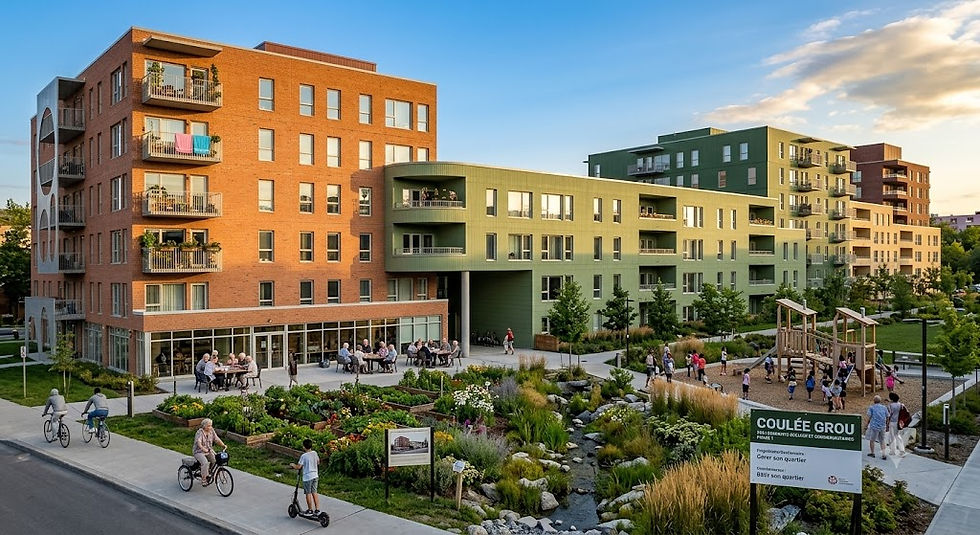
The backbone of the project is a structuring central axis, prioritizing pedestrians while allowing access for emergency and moving vehicles. Ecologically, this layout intelligently manages rainwater: a small swale will collect precipitation and return it to the natural tributary located in the adjacent park.
Residents will also benefit from landscaping, mature trees, inner courtyards, and playgrounds, actively contributing to the reduction of urban heat islands in the city's East end.
A Long-Term Project
While celebration is in order, realism remains essential. This project required six years of efforts (acquisition, planning, financing) before the first shovel hit the ground. The future tenants will move in during the fall of 2028.
It should be noted that the initial vision anticipated a much larger complex of 700 housing units. To break the deadlock in the face of the current housing emergency, the development was split in cooperation with the City of Montreal and the borough.
This delivery of 200 units therefore represents Phase 1. As Michel Taylor wisely points out: "It took six years to make this groundbreaking a reality. I hope the second phase won't take another six years, because in the current context, we need housing so badly."
Eastern Montreal is initiating a necessary transformation here, combining smart densification, ecological responsibility, and social justice. Coulée Grou is more than a building; it is a new beating heart for Pointe-aux-Trembles.