
News
McGill’s $48M Investment in Sainte-Anne-de-Bellevue
Jean Giguère
Author :
WikiResidence
Source :
10/05/26
McGill University has reached a historic milestone in the development of its Macdonald Campus with the inauguration of a state-of-the-art teaching greenhouse and the Eastern Canada Plant Phenotyping Platform (ECP3).
Representing a combined investment of nearly $48 million, these cutting-edge infrastructures aim to secure Quebec’s food supply chain against climate change while bolstering the institutional real estate and academic prestige of Montreal’s West Island.
The urban landscape of Quebec’s university campuses is evolving toward sustainable innovation hubs.
On May 8, 2026, McGill University officially inaugurated its new research and teaching facilities at the Macdonald Campus in Sainte-Anne-de-Bellevue.
This major development is more than just a construction project; it is a structural response to the environmental and economic pressures currently facing the agri-food sector.
High-Tech Infrastructure for a New Era
The project is built upon two major pillars:
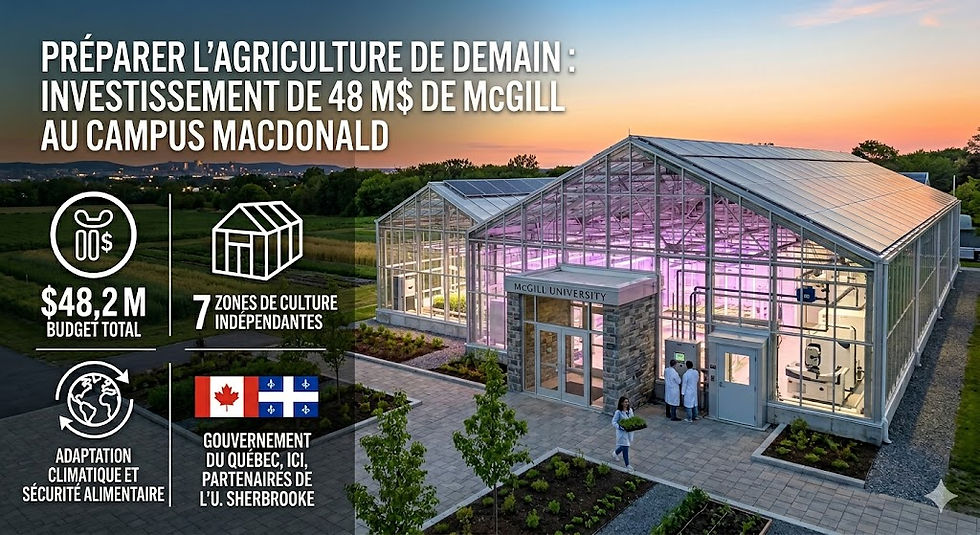
The New Teaching Greenhouse: Located adjacent to the Raymond Building, it replaces aging facilities with a complex featuring seven independent growing zones.
Equipped with full LED lighting and a sophisticated rainwater harvesting system for irrigation, it embodies the latest standards in energy-efficient institutional construction.
The ECP3 (Eastern Canada Plant Phenotyping Platform): Unique in the country, this platform allows for the study of plant resilience through multi-scale imaging and a specialized pest containment facility, positioning the region as a leader in climate-adapted agriculture.
Economic Impact and Allocated Budgets
The total investment reflects a strong political and academic commitment to food sovereignty:
Teaching Greenhouse Component: A $24.4 million investment, with $23 million provided by the Quebec Ministry of Higher Education and $1.4 million by McGill University.
ECP3 Platform Component: A $23.8 million initiative, jointly funded by the Canada Foundation for Innovation (CFI) and the Quebec government.
Economic Spillover: Beyond creating high-skilled research jobs, these facilities solidify Quebec’s position as a global leader in agronomy. This attracts international talent and private investment into the growing "AgTech" (Agricultural Technology) sector.
Timeline and Strategic Development
While this inauguration marks the completion of a major construction phase at the Macdonald Campus, the project is part of a broader collaborative timeline.
In 2024, complementary facilities were erected at the Université de Sherbrooke, creating a specialized research corridor between Montreal and the Eastern Townships via the SÈVE Center. This inter-university synergy ensures long-term data continuity and regional development.
Social Impact and Attendance
The social impact is immediate for the campus community:
Attendance: The facilities are designed to host hundreds of undergraduate and graduate students, providing hands-on experience with production systems that mirror modern industrial standards.
Developing the Next Generation: As noted by student Marie-Anne Lauzon-Miron, access to this equipment provides the practical skills necessary to face real-world agricultural challenges.
Community Resilience: By simulating future climate scenarios, McGill researchers are indirectly protecting the consumer's grocery basket by developing crops capable of surviving heatwaves and emerging pests.
From an institutional real estate standpoint, this inauguration confirms that a campus's value now lies in its ability to offer technological platforms that cannot be replicated at home or in the private sector.
The Macdonald Campus reinforces its role as an economic anchor for the West Island, transforming Sainte-Anne-de-Bellevue into a living laboratory for 21st-century agriculture.
Key Statistics at a Glance:
Total Budget: $48.2M
Growing Zones (Greenhouse): 7 independent sections
Principal Partners: Government of Quebec, CFI, Université de Sherbrooke
Social Goal: Food security and climate adaptation