
News
School Squares: Urban Planning meets Education
Jean Giguère
Author :
WikiResidence
Source :
9/7/26
Continuing our study of the educational system and its urban integration in Greater Montreal, here is an initiative that is attracting more and more attention in the metropolis: school squares (places-écoles).
Through the inspiring example of the Marie-Favery school in the Villeray neighborhood, we analyze how a very low-cost urban intervention can transform safety, neighborhood life, and the local economy.
Discover the financial and social benefits of these projects that are redesigning the metropolis, one street at a time.
Rethinking the Space Around Our Schools
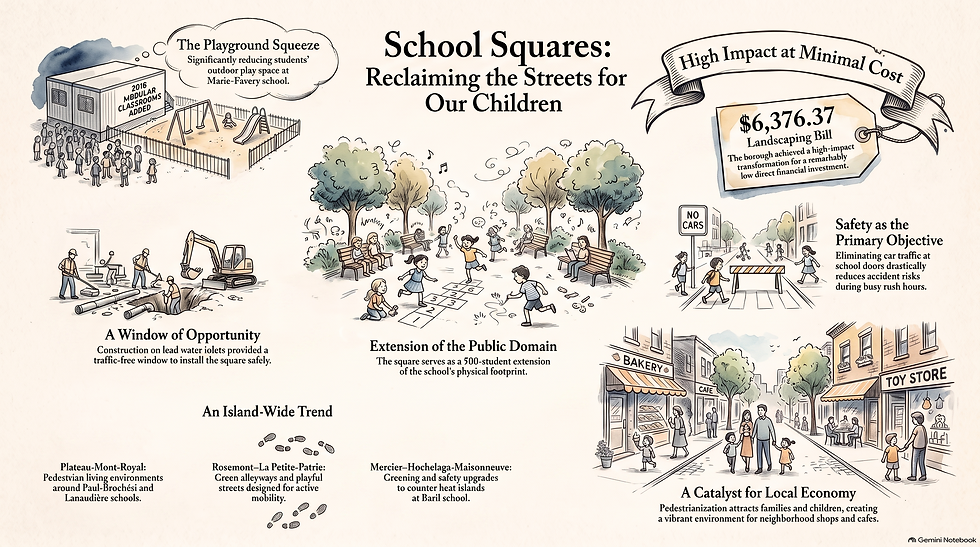
In dense neighborhoods where every square meter is precious, school squares act essentially as extensions of playgrounds onto the public domain.
This is by no means a luxury for several establishments. Take the case of the Marie-Favery primary school, located in the heart of Villeray with an intervention facade on Boyer Street.
In 2018, the necessary addition of modular units to compensate for the lack of indoor space unfortunately ate into the students' play area. The school square became the ideal solution to give the children some breathing room.
Attendance and Profile of Marie-Favery School
Address: 7800 Chateaubriand Avenue, Montreal (QC) (Villeray / Boyer Intersection)
Attendance: The establishment welcomes approximately 500 neighborhood students (preschool and primary levels), a bustling clientele that requires adapted and safe outdoor infrastructures.
The Project: From Idea to Boyer Street
Carried with passion by the school's governing board, this project had been on the drawing board for two years.
The borough finally kicked off the work on August 24, just a few days before the start of the school year.
The reason for this timing? A pure logic of opportunity, explains the local Projet Montréal elected official: the start of a construction site to replace lead water inlets on Boyer Street offered the perfect opportunity to take advantage of the absence of car traffic to set up this small school square in complete safety.
Economic and Financial Impacts: An Exceptional Cost/Benefit Ratio
And how much does it cost to transform a street into a schoolyard? The answer is surprisingly low. This type of tactical intervention is what urban planners call a project that is "small, but high-impact, and at very minimal cost."
Landscaping bill: $6,376.37 (paid by the borough).
Optimized resources: This amount excludes the borough's internal resources and the cost of furniture (such as the concrete blocks securing the perimeter) which were already in inventory.
School involvement: The revitalization and ground painting were financially covered by the school itself.
Future additions: A universally accessible picnic table will be added in the coming weeks.
The Local Economic Impact:
Far from harming businesses, the pedestrianization of these sections creates living environments favorable to local shopping. Mélissa Argueta, owner of the microbakery-café Margo-Lina (located at the corner of Villeray and Boyer with a direct view of the school square), testifies: "It's great. It really brings in families, children."
Social Impact: Safety and Community Spirit
The primary objective of a school square or a school street is not only recreational; it is highly focused on safety. By keeping cars away from the establishment's doors, the risk of accidents during school rush hours is drastically reduced.
Baker Mélissa Argueta perfectly summarizes this feeling of relief shared by residents: "It's really for road safety that I'm in favor. Twice, I almost got hit leaving here." By securing the intersections, the project calms traffic, encourages active transportation (walking, cycling), and creates a community agora where parents can build ties after the bell rings.
Elsewhere on the Island: The Trend in Montreal
The Villeray model is part of a broader movement across the island of Montreal, strongly inspired by the international "School Streets" concept. Here are other convincing examples of similar projects:
Le Plateau-Mont-Royal: The pioneering borough transformed the surroundings of the Paul-Bruchési and Lanaudière schools (De Lorimier Avenue / Lanaudière Street) into genuine pedestrian living environments.
Rosemont–La Petite-Patrie: Numerous green alleyway and playful street projects adjacent to schools, notably near the Saint-Denis school, where public space was rethought for active mobility.
Mercier–Hochelaga-Maisonneuve: The Baril school benefited from safety upgrades and intensive greening to counter heat islands while securing school corridors.
Villeray–Saint-Michel–Parc-Extension: In addition to Marie-Favery, the Saint-Gérard school sector also saw significant redevelopments (De l'Épée Street) to prioritize pedestrians.